Recently four alumni of the Department of Energy Computational Science Graduate Fellowship (DOE CSGF) met and discussed quantum science and quantum computing. They also shared how the DOE CSGF helped their careers and their advice for new fellows and other early career computational scientists. To celebrate the 35th anniversary of the DOE CSGF, we’ve included their answers here as a bonus episode. We hope their insights will help other researchers deepen their careers.
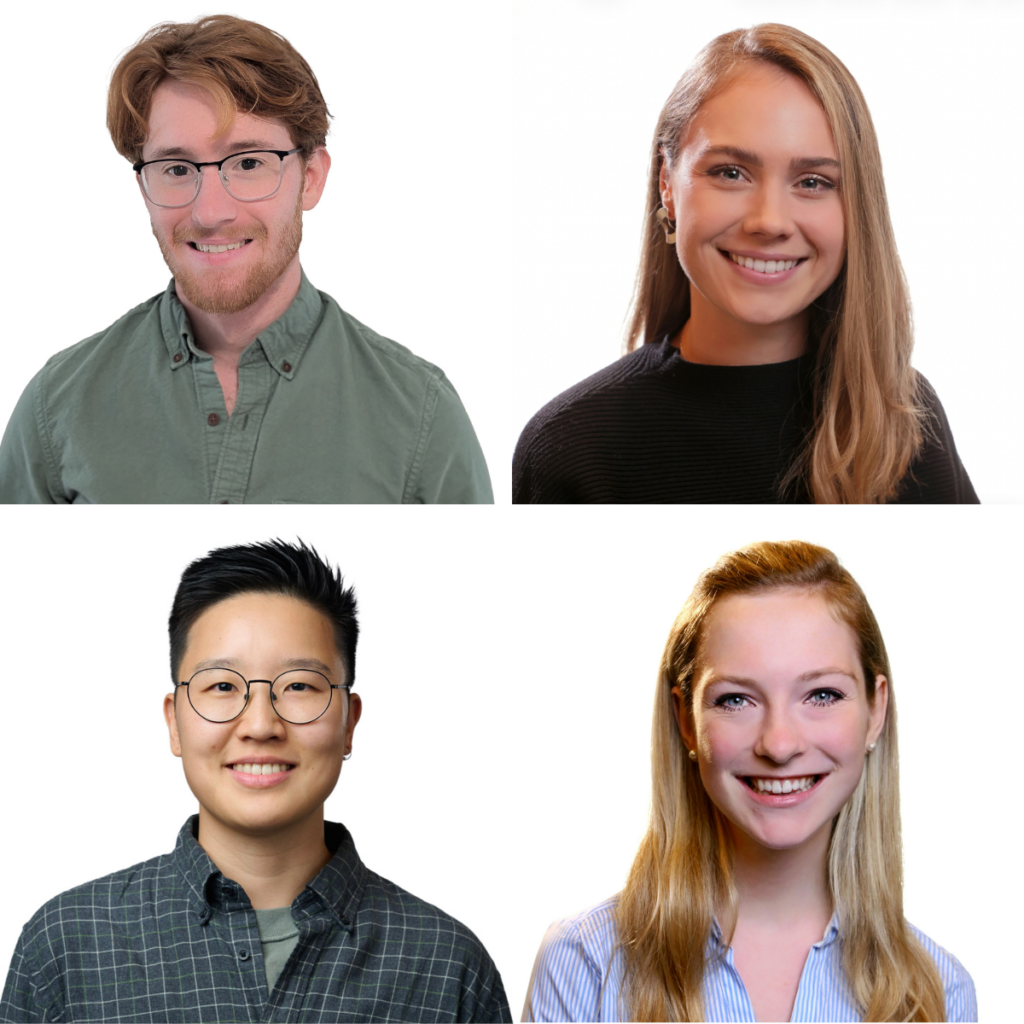
You’ll meet (clockwise from top left):
- Jacob Bringewatt: Assistant Professor of Physics at the U.S. Naval Academy
- Grace Johnson: Senior Product Manager, NVIDIA
- Alicia Magann : Senior Member of Technical Staff, Sandia National Laboratories
- Dylan Sim: Senior Quantum Applications Architect, PsiQuantum
From the episode:
Check out our full episode discussing quantum computing with these four guests: Quantum Quartet: Insider Insights Toward Fault-Tolerant Systems
More information about current DOE CSGF recipients and program alumni are available on the DOE CSGF website. That’s also where you can read more about eligibility requirements and benefits.
The fellowship is awarded annually. Applications open in the fall with a submission deadline in January.
Follow the DOE CSGF LinkedIn showcase page for updates about application deadlines, events and fellow and alumni achievements.
Transcript
Transcript prepared using otter.ai with human copyediting
Sarah Webb 00:03
This is another Science in Parallel short, and I’m your host, Sarah Webb. In our last full quantum computing episode, we brought together four researchers making their mark in quantum science and quantum computing in a round table style conversation, if you missed that episode, I encourage you to check it out on your favorite platform or at scienceinparallel.org.
Sarah Webb 00:32
The other common link among those researchers was that they all were supported by the Department of Energy Computational Science Graduate Fellowship during their PhDs. This podcast is supported by that fellowship program. The full name is a mouthful, so we often call it the DOE CSGF, or just CSGF, as we’re talking. In 2026 the fellowship is celebrating 35 years, and it supported the training and research of more than 550 alumni.
Sarah Webb 01:06
In this bonus episode, our quantum roundtable guests, Alicia Magann of Sandia National Laboratories, Jacob Bringewatt of the U.S. Naval Academy, Dylan Sim of PsiQuantum, and Grace Johnson of NVIDIA talk about the CSGF and how it shaped their careers and contributions to quantum research. We especially hope this discussion about building depth, breadth and research networks will be useful to early-career computational scientists, even those working outside quantum science.
Sarah Webb 01:47
How did the CSGF shape your path into quantum computing? What advice would you give to current fellows or other early career researchers? You’ll hear first from Alicia McGann, a staff scientist at Sandia National Laboratories.
Alicia Magann 02:06
Yeah, so for me the DOE CSGF was so pivotal in bringing me not only to Sandia as a Department of Energy lab, but also bringing me into the field of quantum computing. So I did my Ph.D. on quantum control in a way that had no touchpoint to quantum computing or quantum information science until I did my practicum. So I spent a summer at a national lab, and I decided to come to Sandia and learn about quantum computing and do a project on that. I’m not sure what my expectations were going in, but I never would have imagined that I completely fell in love with quantum computing, and that I never left Sandia since. So, I mean, for me, the opportunity to do that summer practicum and explore a different research area relative to what I had done up to that point really changed everything for me. And so I wouldn’t be here, I’m sure, if it weren’t for the DOE CSGF fellowship.
Alicia Magann 03:09
And in terms of advice, I would encourage people to take advantage of that summer in a DOE lab to really do something that is a little different and explore, because I think it can have a big impact on your research after it can potentially impact your career. And it’s a really, really cool opportunity that you get through the fellowship.
Sarah Webb 03:29
And now Jacob Bringawatt, who is a physics professor at the US Naval Academy.
Jacob Bringewatt 03:35
So, Alicia’s right, that’s basically what I have to say. No, I came in interested in quantum computing, but I did take advantage of the practicum, giving me an opportunity for breadth. So I did my practicum at Jefferson Lab, and did just a nuclear phenomenology project with nothing to do with quantum computing. But then since then I’ve come back and I’ve been working with nuclear physicists, thinking about quantum algorithms for lattice QCD or gauge theories, and so having that opportunity to expand my breadth from the practicum, I think was super important.
Jacob Bringewatt 04:11
And then, just generally speaking, the fellowship giving me the opportunity to have funding to be able to work with a wide variety of people. We’ve talked about how this is an extremely interdisciplinary field. I think broadly speaking, computational science is interdisciplinary, whether you’re working in quantum computing or not, right? There’s both the algorithms and computing aspect of things and the science aspect of things, and I think it’s really important how the fellowship encourages that breadth, and I encourage current fellows to take full advantage of that. I think it’s these in between regions, between disciplines, between fields, talking to as many people as possible outside of your little bubble of expertise. I think is where a lot of good ideas come from. And so I’m extremely grateful for the fellowship, and I encourage everyone to take full advantage of the breadth that it offers,
Sarah Webb 05:02
And Dylan Sim, who designs quantum algorithms at PsiQuantum.
Dylan Sim 05:07
Yeah, I would say what you both just said. And one thing that I’ve kind of forgotten about is kind of like the course of study that they recommended. I think coming from a chemistry and physics background from undergrad, it kind of encouraged me to take courses and learn more from fields of applied math and computer science. One of my favorite classes during grad school was on numerical methods from the Applied Math department, and a lot of those kind of methods and skill sets that I’ve learned from that class I still kind of used to this day in my current research, so it definitely was incredibly useful to my career.
Dylan Sim 05:47
And what Alicia and Jacob just said about the opportunity to meet different people, especially at the annual conferences. I met a lot of CSGF scientists who may not actually come from quantum computing backgrounds, but we got to have some really good conversations, some of which kind of led to new ideas for my own research, and I hope I had similar impact on their research as well, as well as, of course, the funding I was able to work on the projects that I was curious about throughout grad school, and I realized that’s an incredible opportunity and privilege.
Dylan Sim 06:23
So this kind of relates to, I guess, my advice, which would be leverage the funding and the network you have, and go to a lot of conferences. I’ve always enjoyed the ones that I’ve gone to. I wish I’d gone to more, and I will be attending more in the future. I think conferences are incredible ways to broaden your horizons and make sure that you’re not stuck in kind of an echo chamber when you’re doing your research. I definitely am guilty of that a lot of the times, and then whenever I go to conferences, I’m like, oh wait, there’s like a whole field out there, and I might actually be, for example, suboptimally optimizing my quantum circuits, if I just focus on whatever I only care about day to day, from all this like additional information from other folks about quantum error correction or quantum architectures that actually helps my job, as well as just grow as a scientist. So, yeah, definitely grateful for the DOE CSGF opportunities,
Sarah Webb 07:23
And, finally, Grace Johnson, who develops quantum products at NVIDIA
Grace Johnson 07:28
Yeah, I totally agree with Dylan about the coursework. I, you know, came from from chemistry, and in my undergrad, and you know, I actually didn’t really program until grad school, and the coursework that I did as part of the CSGF totally shaped my Ph.D. And then what I’ve ended up doing afterwards, I was at HPE before this, now I’m at NVIDIA, so this kind of high-performance-computing industry perspective has really shaped my research, and then shaped how I’m thinking about quantum computing, and it was fantastic. I took so many interesting courses, and then also being at the summer events every year, again echoing what other folks said, being able to get a sense of the breadth of all of the research that’s done in computational science, all of the facilities and capabilities that happen at the national labs has been really impactful on my career.
Grace Johnson 08:24
And I would say my piece of advice sort of follows from that, but is a little different, which is that you know, I think that I’ve realized that obviously you want to find work that you’re interested in, right, work that you feel is important and meaningful, but I think that who you work with is maybe more important than what you work on. And so if you can find people, maybe they’re from different disciplines, you know, different kinds of roles, but if you can, find people who you really like working on interesting problems with.
Sarah Webb 08:55
Thanks again to Alicia Magann, Jacob Bringewatt, Dylan Sim, and Grace Johnson for a great discussion about quantum computing. And if you like what you’re hearing here on Science in Parallel, please take a moment to help us out. We’d love it if you subscribed on your favorite platform, rated us there or recommended the show to a colleague. Thank you.
Sarah Webb 09:20
Science in Parallel is produced by the Krell Institute and is a media project of the Department of Energy Computational Science Graduate Fellowship program. Any opinions expressed are those of the speaker and not those of their employers, the Krell Institute or the U.S. Department of Energy. Our music is by Steve O’Reilly. This episode was written and produced by Sarah Webb and edited by Susan Valot.