In the new season of Science in Parallel, we’re focusing on collaboration, the human glue that fuels interdisciplinary research like computational science and engineering. Collaborative connections come in many shapes and sizes, but their origins often start in a conversation. What starts as talking over a cup of coffee or an email asking for advice can lead to new projects and more. In the first two episodes, Ethan Meitz of Carnegie Mellon University will join us alongside two different collaborators, one in each episode. First, he joins us with one of his Ph.D. advisors, Jerry Wang. Together they talk about molecular simulation, heat transfer and how conversation has shaped Ethan’s research.
You’ll meet:
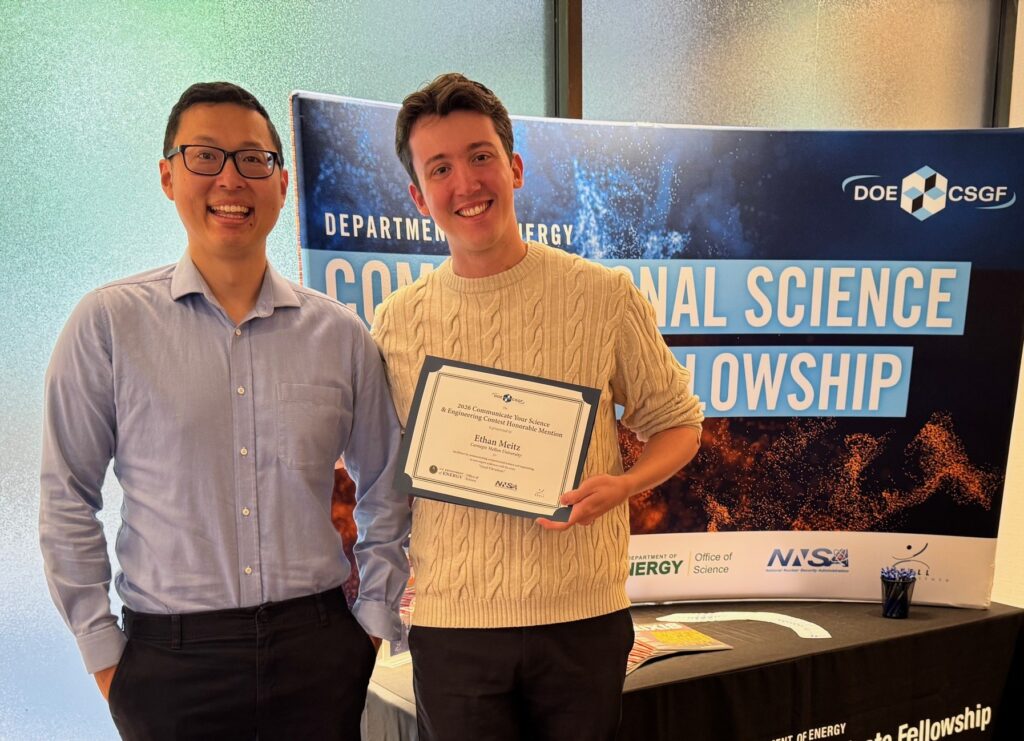
- Ethan Meitz (right), a mechanical engineering Ph.D. student at Carnegie Mellon University and a fourth-year Department of Energy Computational Science Graduate Fellow (DOE CSGF). He works with Alan McGaughey, in the mechanical engineering department and
- Gerald (Jerry) Wang (left), associate professor of civil and environmental engineering at Carnegie Mellon University. Jerry was a DOE CSGF recipient from 2014 to 2018.
From the episode:
The first paper that Ethan and Jerry published together was this one: Phonon mode resolved anharmonic heat capacity of solids (abstract free, full text with subscription).
Ethan discussed his DOE CSGF practicum research with Arvind Ramanathan of Argonne National Laboratory.
We’ve talked about research by Arvind and his team in two earlier Science in Parallel episodes: Pushing Limits in Computing and Biology and Danilo Pérez: Embracing Versatility
Jerry and Ethan mentioned Steve Brunton, a mechanical engineering professor at the University of Washington, and his YouTube channel.
Ethan wrote a short essay, Good Vibrations about his research . It was an honorable mention in the 2026 Communicate Your Science and Engineering (CYSE) contest.
Jerry is also known for his humor, as seen in this video produced by Carnegie Mellon.
Transcript
Transcript prepared using otter.ai with human copyediting
Sarah Webb 00:03
This is Science in Parallel, and I’m your host, Sarah Webb. We’re launching our eighth season of episodes, where we’ll discuss computational science collaborations. In these conversations, we’ll explore scientific synergy as researchers identify problems and solve them together. In this first episode, I’m talking with a classic collaborative pair: a Ph.D. student, Ethan Meitz, and one of his advisors, Jerry Wang. Ethan is starting his fourth year as a Department of Energy Computational Science Graduate Fellow, and Jerry was a fellow, too. This podcast is supported by the fellowship, which we often refer to as CSGF for short. The theme that came up over and over again as we talked was the role of conversation in Ethan’s work, in his interactions with Jerry, as he finds outside experts, and as he mines decades-old research papers for new insights, I hope you’ll enjoy hearing from Ethan and Jerry as much as I did.
Jerry Wang 01:21
Hi, folks. My name is Jerry Wang. I’m an associate professor of civil and environmental engineering at Carnegie Mellon University. I’m originally from Chicago, Illinois, and I had the pleasure of being a part of the Department of Energy Computational Science Graduate Fellowship from 2014 to 2018.
Ethan Meitz 01:37
My name’s Ethan Meitz, and I’m one of Jerry’s Ph.D. students. I’m also co-advised by Alan McGaughey, and I’m in mechanical engineering. I’m originally from St. Paul, Minnesota, and I did my undergraduate at Wash U in St. Louis.
Sarah Webb 01:50
To start us off, I think it would be good for us to learn a little bit about the kinds of research questions that each of you are interested. Jerry, could you take it away? Talk about your work and the kinds of things that get you excited day to day.
Jerry Wang 02:03
So I am in the Civil and Environmental Engineering Department at Carnegie Mellon University, with courtesy appointments in Mechanical Engineering and Chemical Engineering, and broadly my research interests sit very much at the nexus of these engineering departments. I’m very interested in the use of particle-based simulations to solve all kinds of problems related to the design of materials for applications to civil and environmental and mechanical and chemical problems, a lot of problems of sustainability and energy, and trying to make the world tomorrow look like a like a better place.
Sarah Webb 02:34
Ethan,
Ethan Meitz 02:35
My research interests are very much in line with Jerry, as you might imagine. I’m very interested in how we can use molecular simulation tools and how we can improve them to be more accurate, more user friendly, and overall just more computationally efficient. Because a lot of these tools that we end up using, they pretty much have to be a power user, someone who’s spent like years and years working on these things to understand everything about them, and that’s just not a good state for anything to be in. So I’m hoping to improve that and make these tools better at the same time.
Sarah Webb 03:03
How did the two of you end up working together? Was the CSGF what brought you together, or did the CSGF kind of come out of working together?
Ethan Meitz 03:14
The CSGF definitely came out of working together. So I met Jerry just when I was interviewing for Ph.D. programs, and I remember that our first interview together-it was just me and him-and then I met Alan separately. And Jerry and I’s interview-we just kind of got sidetracked. I forget what we’re talking about specifically, but we got very distracted and did not actually do the interview. So we had to reschedule and meet another time later. So I think that was one of the main reasons that I accepted because I just had such a fun time talking to Jerry in that interview.
Jerry Wang 03:42
There’s a wonderful coincidence of personalities, and it’s something that I felt tremendously lucky about, and also made a deep impression. But I’ll say this: when Alan, when Professor McGaughey and I were first interviewing with with many, many students on this project that we were looking to recruit a student on, something that really really really stood out about you, Ethan, which is something that the fellowship has so has forever prized– and really for me as a PhD student put on my radar–was the importance if you want to make an impact in computational science and computational engineering, that you be very very enthusiastic about domain science, domain engineering, about mathematics, and about computer science. And Ethan was somebody who just you know the two things that Alan and I talked about after our interview with you, a just the tremendous enthusiasm for all the things that it would take to make an impact in the kind of Ph.D. project that you’d be pursuing. And then the other thing we talked a lot about was the skates that were hanging on the wall behind you, and Alan being Canadian and being a very enthusiastic hockey player, that was something that jumped out to both of us, and to him in particular.
Ethan Meitz 04:47
I forgot that detail, but yes, yeah, I’m from Minnesota and I do love skating, but I am not as big of a hockey fan as Alan, unfortunately. Thankfully, he did not he did not realize that during the interview.
Sarah Webb 04:57
So, talk about this project. Then, I mean, what was the idea, and how has it developed?
Ethan Meitz 05:07
The original idea was to look at broadly liquid systems and try to understand the physics that describe their thermal properties. There aren’t really great models or understanding for liquid systems just in general, and we were hoping to kind of elucidate some of that,and then demonstrate it with molecular simulation tools.
Jerry Wang 05:27
So, a big question at the heart of this, at the heart of what Ethan’s been studying throughout his Ph.D., is how you can predict on a computer just how much heat you could store in a solid, in a liquid, in various kinds of materials. How much heat could you possibly store in that? How can you move heat through these materials? On some level, these are really simple questions, and we think about them every day when you try to cool something in your fridge or freezer, or you put a cube of ice in something, or you run a fan over something. These are things that we think about all the time. But the fundamental physics of what’s going on, storing heat in a material, it’s actually really like crazy subtle and unintuitive stuff. And Ethan’s really shed a lot of light on some of these challenging problems during his Ph.D.
Sarah Webb 06:08
Once you got the fellowship, how did that change the kinds of things you were working on, the kinds of questions you were thinking about?
Ethan Meitz 06:15
So the project was already kind of moving in a different direction because we had some very solid results, but they were actually for solid materials, which of course is not a liquid. So the first paper I wrote ended up being about these solid materials and the things that I had discovered about them. And with the new-found funding from the CSGF, there was a lot more questions that I was interested in tackling there. And the liquids, well, it didn’t feel like like an actual dead end. It was a much more challenging direction. There wasn’t much precedence. There wasn’t a lot to build off of.
Sarah Webb 06:48
Jerry also brought up Ethan’s practicum experience at Argonne National Laboratory, where Ethan spent a summer working in a totally different research area: computational biology.
Jerry Wang 07:00
And that’s an experience that every fellow in this program has, where they delve into something that’s totally different than what they’re doing day to day. And I feel like the thoughts that you’ve had, for example, on heat transfer in proteins, there’s like just a lot of nifty, neat, weird things that you’ve been able to think about because you took a summer to think about problems that have nothing to do with your Ph.D. research.
Ethan Meitz 07:23
Yeah, so I guess to give a little background, my my actual research is like nanoscale heat transfer in liquids and solids, and my practicum was on I guess drug discovery for proteins, computational biology in general. So completely different field, and the stuff I was doing in my practicum was not at all related to heat transfer. It was like pure machine learning, trying to create models that can predict proteins that bind to other proteins.
Sarah Webb 07:47
So, where did you work, and who did you work with to start with?
Ethan Meitz 07:49
I worked at Argonne National Lab, and I was advised by Arvind Ramanathan, and I still, to this day, interact with that group, and I’m trying to wrap up some projects that I was working on there, even though it was well over a year or maybe two ago, at this point.
Sarah Webb 08:07
If you’re a long-time Science in Parallel listener, Arvind Ramanathan’s name might sound familiar. Two of our past guests, Anda Trifan and Danilo Perez, talked about their work with Arvind and his team, and some of that work was mentioned on our recent fifth-anniversary episode. We’ll include links to those episodes in our show notes.
Ethan Meitz 08:29
Yeah, so I worked on a class of proteins that are known as intrinsically disordered proteins. So these are proteins whose structure is maybe not well-defined by a single kind of snapshot. So like you hear these things like AlphaFold, they like solve the protein folding problem, and the newer versions of that, that’s maybe more truth. But like the first version or two of AlphaFold, I would argue definitely did not solve this problem. They probably solved it for very rigid, structured proteins. But a lot of proteins are kind of flexible. They’re like wet spaghetti. They just flop all over the place. They’re not. They don’t have a single well-defined structure, and because of this flexibility, they actually interact with far more things in our body. And because of this, they’re implicated in a lot more disease pathways because they combined with so many things instead of just having a single specific target that they bind to.
Ethan Meitz 09:19
And this flexibility also makes it really hard to design a molecule that binds very tightly to the disordered protein. So most of their interactions tend to be pretty weak., which, if you’re trying to inhibit the function of that protein, is not a good thing. You want something that binds very tightly to it and just prevents anything else from ever binding and messing with that protein. So this was kind of an open question of like, how can we take something we know is intrinsically disordered and find something that binds to it? And then there was a higher-level question of like, well, how do we know something is like disordered has this flexibility to begin with? There wasn’t really good data sources or data labeling around that, like there is for the proteins that the original like AlphaFold model is trained.
Sarah Webb 10:00
And how do you feel like that experience and thinking about those types of computational biology questions has come back to your work at Carnegie Mellon?
Ethan Meitz 10:10
The machine learning tools and I would say high performance computing stuff there is definitely a completely different flavor than what I get in my Ph.D. My final Ph.D. project might have machine learning in it as a result of what I did at the practicum. But before the practicum, I had nothing to do with machine learning. I I like understood the math because I took classes through my program of study, but I’d never actually used it in practice. And the program of study gave me the opportunity to actually go and do that, and not only just like go run it on my laptop, but like use the Aurora supercomputer. So I got to go use a leadership class supercomputer to actually go and run the machine learning stuff that I was learning on. So bringing that back to my research, the kind of biological stuff doesn’t really apply that much.
Ethan Meitz 10:52
But it turns out that the heat transfer does apply to proteins quite heavily. I went and found this textbook online. I just searched heat transfer in proteins, and I just kind of reading, and I found this textbook that literally like everything in it was like our entire field, everything I researched, but applied to proteins, and it was just a body of literature that I had never seen before. I don’t think Alan or Jerry had ever seen it before either, and I found it really interesting because like these people are tackling and asking questions like 20 years earlier than anyone in our field was really asking these questions, and it was interesting to see which problems they stopped working on because maybe they were too hard, and what new solutions they had for problems that our field wasn’t really working on or looking at because we were just focused on like crystalline materials, whereas these people were working with proteins, which are obviously a much more complicated system than just like a perfect crystal,
Sarah Webb 11:41
It’s really interesting to think about how interdisciplinarity helps you to start to bring those different ideas that people are thinking about in one context.
Ethan Meitz 11:50
Yeah, like the Google search was simple, like proteins and heat transfer. But I never would have thought to Google search that had I not done the practicum.
Sarah Webb 11:58
That’s really really cool. So I want to talk a bit about question for you, Jerry. In terms of you know, you were a CSGF fellow. Talk about what you think the meaning of the fellowship has been for you, and do you view that differently now than when you were, say, in Ethan’s shoes.
Jerry Wang 12:24
Yeah, that’s a really good question. So it’s it’s totally different now because it’s the same paperwork, but I just sign on a different line, and so it’s it’s categorically different. In earnest, there’s a lot of perspective that I got, and I felt extremely lucky to have a very supportive Ph.D. advisor, Nicolas Hadjiconstantinou, in mechanical engineering at MIT. I had a an advisor who understood through and through the kind of spirit of the fellowship, and so I had a very positive Ph.D. experience. And I feel being on the advising side now and working with a co-advisor, working with Alan McGaughey, who also very much understands the power of the intellectual flexibility afforded by the fellowship.
Jerry Wang 12:49
It’s so cool to see a PhD student like Ethan take that flexibility and then run with it and do amazing things with it and work on all kinds of projects that Alan and I are very closely involved with, and then also work on a whole panoply of projects that we have moderate involvement with, and minimal involvement with, and zero involvement with, and everywhere in between, and then to hear from time to time where all of these different directions of pursuit are going. It’s something that’s so unique about this fellowship, and it’s true to some extent about all of the federal fellowships. This is a fellowship that does so much, that invests so much of its resources into giving students this runway to be very deeply intellectually creative, and so I really enjoyed that being a student. And it is 10 times cooler to see on this side a very, very creative student running with that freedom.
Sarah Webb 13:57
And for you, Ethan, as a fellow and finishing up your third year, what do you think the benefit for you has been to be mentored by someone who has had this experience?
Ethan Meitz 14:09
I think the biggest benefit for me is that, well, the independence of having funding and being able to go in my own research direction is amazing and has afforded me all these opportunities from the practicum to going to supercomputing and working with NVIDIA on a separate project and being able to work on these things that Alan and Jerry have no idea about, and then just one day showing up to a group meeting and like, oh, here this is what I was working on instead of my Ph.D. research. I hope you’re still interested.
Jerry Wang 14:37
And we are.
Ethan Meitz 14:38
Yeah, thank you. But because I’m working on all these kind of random things that are maybe not related to the Ph.D. research, I’m also the only person in the research group working on these things or in these directions, and sometimes that can be it can be difficult. Like Ph.D. is already– there’s like a loneliness aspect to that, but collaboration is is also very important, and because even Alan and Jerry aren’t necessarily experts on the things I’m working on. They don’t do proteins or, or like GPU programming or things like that. And Jerry and Alan have both been really helpful with that. Like I can, I have no problems just coming and saying like, look, like I’m having like issues like working or like I’m burnt out on this stuff because I’m the only person doing this and I’m very stuck and I like don’t know who to ask for help, and like very open to talk to Jerry and Alan about that, and I’m very grateful for that.
Sarah Webb 15:26
How have you overcome those challenges when you are working on something where you need, you know, expertise that perhaps isn’t down the hall?
Ethan Meitz 15:35
The first thing I always do is like if I feel like that stuck, that exasperated, is always just to like stop and go, like, there’s so many other things that I find interesting that I can work on. That this thing doesn’t need to happen by like tomorrow. Very rarely in I found in Ph.D. is there like a deadline that is like externally imposed on me. Like I can wait a week or two and work on something else and push forward on on these things. I do think a lot of times I just cold email people, and the amount of times that that just like works. Like there’s a professor on YouTube called Steve Brunton, who a lot of people are probably familiar with. He’s a very amazing educator, and based on the amount of views he gets on his YouTube channel and the amount of citations his papers has, you would expect that a Ph.D. student just cold emailing him, he would ignore them or not even see the email. But he replied in like very long email, very detailed explanation, like before AI. So this was like not like an AI-generated response, and like it was a very helpful answer.
Sarah Webb 16:33
As we talked, Ethan also mentioned a software project that he’s working on with another CSGF Fellow David Krasowska of Northwestern University and researchers at NVIDIA. I wanted to learn more about it, so I scheduled a separate interview with them, and that will be our next episode on the podcast. So please subscribe or follow our LinkedIn page so that you won’t miss it when it drops.
Ethan Meitz 17:01
So you don’t always just have to sit at your desk alone and kind of wallow in self-pity. Like you have things that you can do. You have agency. Everyone with the fellowship and most PhD students are smart enough to go tackle these problems and go talk to other people because people just want to collaborate, is what I’ve found. So just like reaching out to people cold or like showing them, like, hey, I have this idea. It works out a lot of the time. Sometimes it doesn’t, but when it does, it’s very rewarding.
Jerry Wang 17:27
There’s a kind of seize-the-day mentality that is true of so many of the most effective scientists and engineers of every flavor. And Ethan just has that kind of seize-the-day energy and mentality and approach to all the work that he does. So, of course, Ethan’s the consummately modest person. But all the things that he’s saying about being a bridge builder, community builder, community nucleator, talking to people, and finding those people that are the most useful and relevant to talk to on a particular problem and bring people together-that’s something that Ethan’s just phenomenal at.
Sarah Webb 17:59
What else do each of you think is important to mention around this topic of collaboration and scientific synergy?
Ethan Meitz 18:08
I have one more thing, maybe. I think one of the maybe superpowers I have when it comes to research is being able to connect things across many fields, and much of that is due to like the practicum. And I find most new interesting things in research come from just looking at something someone did in one field and being like, oh, like that’s useful over here in this completely other field that no one’s ever really thought about. And a lot of my research is just like taking like there’s this textbook from 1960 where everyone just derived things analytically because computers didn’t exist, and then going and reading and understanding what they did, and being like, okay, like that’s a useful equation. Let’s go and implement it on a computer.
Ethan Meitz 18:45
I think stuff like that is is really important, and is also why AI is so useful a lot of time because it’s just such a good search engine. It understands, on some level, all these different fields, and it can connect the dots in a way that humans a lot of times cannot. So I think that is probably the best way to get synergies to like look at other fields, look at what other people have done. Don’t just like focus on your narrow field because you might find something, but there’s a better chance you’ll find it elsewhere. Because a your field is just one field, and there’s 1000s of other fields.
Jerry Wang 19:18
So it’s funny that you say this because it took right out of my mouth and put so fantastically a thing that I think is worth emphasizing, it’s worth talking about, and it’s also worth shining a light, Ethan, on what your enthusiasm and skill set really, really has. So much of doing cool, interesting, creative research is finding neat ways to be in conversation with the past, with the past, like your own understandings and misunderstandings of a problem, the past, like all the work that has been done before you-a year, 10 years, 50 years before you-one of the real nifty things that Ethan’s done so much of in his PhD that I think is cool and is something that I aspire to, and I think every computational scientist and engineer should aspire to, is to. To find ways to breathe new life into scientific ideas that came maybe just a little bit too early, a little bit too ahead of the curve, ideas that were brought into being before computers reached their present level of power.
Jerry Wang 20:15
There are so many interesting scientific ideas that did not get their moment in the sun because they came just a little bit too early, and so if one has the patience to read older literature-not stuff from like not like 2023 old, but like 1973 old-if one has the patience to read through that literature, there’s like a lot of really cool computing that you can do, including a lot of computing that Ethan has done during his Ph.D. But you got to have a whole lot of superpowers to make that work. You got to have a certain kind of patience. You’ve got to have a willingness to learn bodies of ideas that really have not been in vogue for a long time. You have to have a willingness to read through typesetting that doesn’t look like modern typesetting. That’s probably the single biggest superpower that you’ve got to have, and that means reading through fractions and integrals and sums that just do not look like this, like 1995 equation editor, but we’re talking like this is this is all typewriter and smudges and bizarre fractions.
Ethan Meitz 21:10
Math is the universal language, but when literally every symbol in the equation changes, it is it is almost a different language.
Sarah Webb 21:16
So, Jerry, what is your favorite thing about working with Ethan? And Ethan would be your favorite thing about working with Jerry.
Jerry Wang 21:22
You can’t teach Minnesota nice, and that’s Ethan through and through.
Ethan Meitz 21:27
I don’t have as as nice of a platitude as Jerry, so I will just I will just try to explain. The first thing is just from the very initial meeting, the enthusiasm and curiosity Jerry has. But the second is that, like, while Jerry is my advisor, I definitely consider him my friend. He’s someone I could just go and and talk to like at the last program review. Like I just walked up to Jerry and he was just talking to like as far as I know someone he had just met and they were like like thank you for like listening to me. Like you made me feel seen I was like that’s definitely like that’s Jerry. That sounds exactly like the person I’ve come to know over the last four years. So I’m very grateful to have not just a good academic advisor but a good life coach, if you could call him that.
Sarah Webb 22:02
Well, Jerry, Ethan, thank you both. It’s been such a pleasure.
Ethan Meitz 22:06
Thank you,
Jerry Wang 22:07
Thank you, Sarah.
Sarah Webb 22:11
To learn more about Ethan Meitz and Jerry Wang and their computational collaborations, both working together and with others, please check out our show notes at scienceinparallel.org. We’ll have links to the other episodes I mentioned and Steve Brunton’s YouTube page. Science in Parallel is produced by the Krell Institute and is a media project of the Department of Energy Computational Science Graduate Fellowship Program. Any opinions expressed are those of the speaker, and not those of their employers, the Krell Institute, or the U.S. Department of Energy. Our music is by Steve O’Reilly. This episode was written and produced by Sarah Webb and edited by Susan Valot.